Key takeaways
- US$8 per person, paid at the gate. Durango’s and Farmington’s tourism sites still publish US$5, which is the old rate — that is why you find two numbers. What a visit costs.
- Carry cash and a card. Discover Navajo says “CREDIT CARD PAYMENTS ONLY”; the Durango and Farmington tourism sites say cash only. Both are official and they are opposites, so I take both and phone (928) 206-2540 before a long drive.
- The gate runs on Navajo Nation time. The Navajo Nation observes Daylight Saving Time and the rest of Arizona does not, so in summer the monument is an hour ahead of Phoenix and a phone driving up from there can be an hour slow. Hours and the time-zone trap.
- Three official sources publish three different hours tables. I lead with the operator’s: 8:00am–8:00pm from 23 May to 14 Aug, 8:00am–5:00pm from 1 Oct to 27 Mar, with the vendors and the office on 8:00am–5:00pm daily all year. The full table, and who disagrees.
- New restrooms opened on 4 August 2026 — a US$3.58 million build announced by the Navajo Nation Office of the President, replacing a building it called structurally unsound. Every guide still describing portable toilets is out of date. Food and facilities.
- No tour goes to the monument. Two Mesa Verde tours describe a viewpoint over the four-state region from roughly 49 miles away, which is a view and not the marker. The eight nearest tours.
What the US$8 buys, and what it does not
The fee covers the site. Everything else is on you, and two items in the right-hand column catch people out at the booth.
Included in the US$8
- Entry to the plaza and the marker disc itself, for as long as you like inside opening hours
- The vendor stalls and the demonstration center, when vendors are trading — the stalls are independently run and nobody guarantees they will be there
- The new restroom building, opened 4 August 2026
- Children 6 and under, reported free — the only exemption any source documents
Not included — and not sold at all
- An advance ticket. There is no such thing, from the Navajo Nation or from any reseller
- Any federal pass. Navajo Parks states it in capitals: “WE do NOT Accept the National Park Pass”
- Food or drinking water you can count on. Water service reached the site in 2016, but no source confirms public drinking water — bring your own
- Drones and dogs, both prohibited at Navajo Tribal Parks; Navajo Parks says drones “will be confiscated”
What a visit actually consists of
Thirty to sixty minutes, and this is where they go.
You pay at the booth, walk out onto the plaza, wait your turn at the disc, take the photograph, and work along the ring of stalls on the way back to the car. There is no trail, no visitor center film and no loop road.
- The booth — US$8 a head for everyone in the car, paid on arrival. No timed slot, no queue-jump, nothing to show.
- The plaza — A low, open slab at about 4,861 feet with the four state seals set around it. Nothing published says there is shade, and I have never found any.
- The disc — The center marker is a disc set in granite, installed in 1992 by the Bureau of Land Management. People straddle it or lie across it to get an arm and a leg into four states at once. In July there is a line for it.
- The stalls — Navajo vendors sell silver and turquoise, woven rugs, ceremonial baskets, frybread and Navajo tacos. Vendors and the office keep 8:00am–5:00pm, so a summer evening finds the marker open and the market shut.
- The restrooms — New since 4 August 2026: eight women’s restrooms including an ADA-accessible unit, four urinals, three men’s stalls and an ADA-accessible men’s restroom.
Then you drive. Cortez is 39 miles, Durango 85, Monument Valley 97 — the full table, and the method behind it, is on getting there. If you want longer than an hour out of the day, the thing to add is Mesa Verde, 49 miles east.
How a visit works, in order
Book nothing
There is no ticket to buy for the monument. Anyone charging you in advance for entry is selling you something else.
Check the day
It closes on New Year’s Day, Thanksgiving, Navajo Nation Family Day, Christmas and all other Navajo Nation holidays, which are not federal holidays. No source publishes live status, so phone (928) 206-2540.
Set your watch, not your phone
In summer the monument keeps MDT with Colorado, New Mexico and Utah. Phones coming up from Phoenix or Flagstaff can sit an hour behind.
Carry US$8 a head, both ways
Cash and card. The two official answers on payment contradict each other, and the nearest supplies are a trading post 6.5 miles away.
The nearest thing to a Four Corners tour — and it is not one
This half-day Mesa Verde tour stops at what the operator calls “one of the most spectacular viewpoints in the Southwest, where you can see into the four states that make up the four corners region.” That is a view across the region from roughly 49 miles away, and it costs nothing at any gate. It does not visit the monument. Park entry is included; the US$8 at the marker is a separate thing you pay yourself, on a separate day, if you drive out.
The three Mesa Verde tours, 49 miles from the marker
The nearest guided products to the drive you are already making. Compare them like with like: the cheapest excludes the park entrance fee that the other two include.
| Mesa Verde: 700 Years Tour & Ranger-Guided Cliff Palace Visit | Sees four statesMancos: Mesa Verde National Park Half-Day Tour | Durango: Mesa Verde National Park, Cliff Palace Tour with Lunch | |
|---|---|---|---|
| Price | US$136.74 | US$140.61 | US$206.01 |
| Mesa Verde entry | Not included — the operator lists US$30 per vehicle | Included | Included |
| Length | 4 hrs | 4 hrs | 8 hrs, max 10 people |
| Departs | Mesa Verde | Mancos | Durango |
| Rating | 4.8 from 53 reviews | 4.6 from 33 reviews | 5.0 from 35 reviews — a thin sample |
| Four Corners Monument | Does not go there | Does not go there — a viewpoint over the four states | Does not go there — a lookout over the region |
| View → | Check availability → | View → |
Photo Gallery
Four Corners, photographed by people who were standing there
The disc, the inscription, the plaza, the craft galleries and the drive in — every frame a real photograph, credited below.
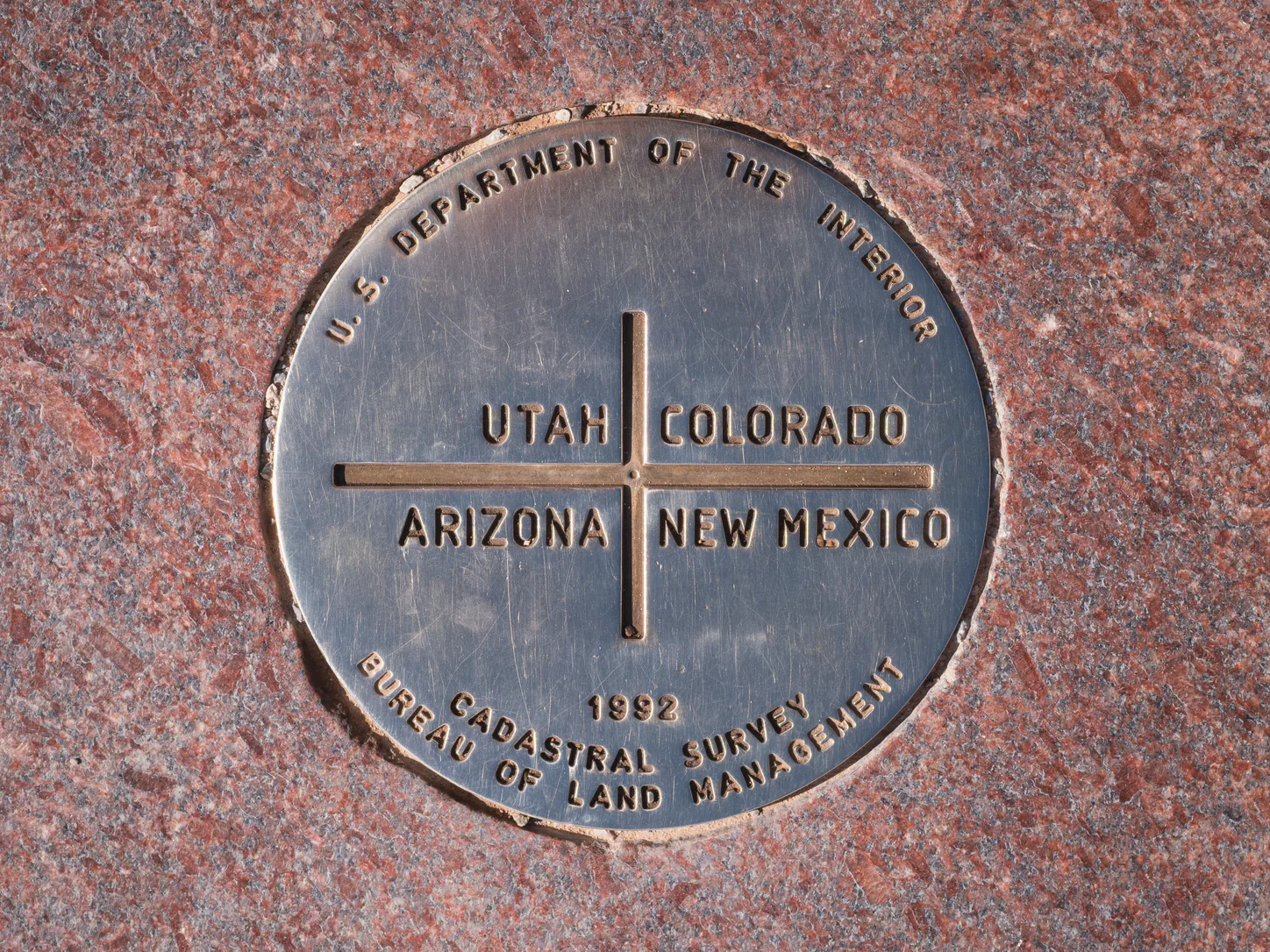
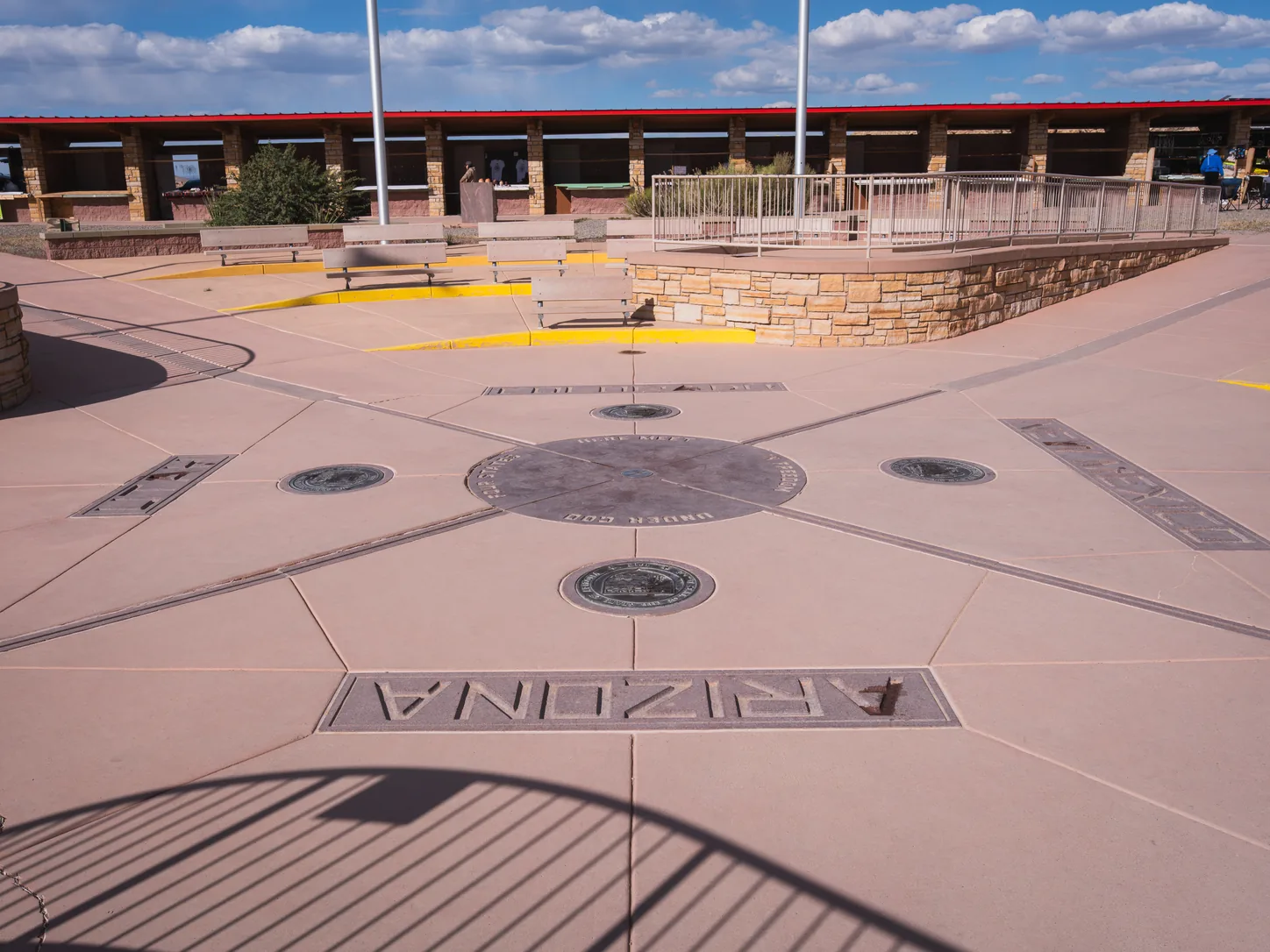
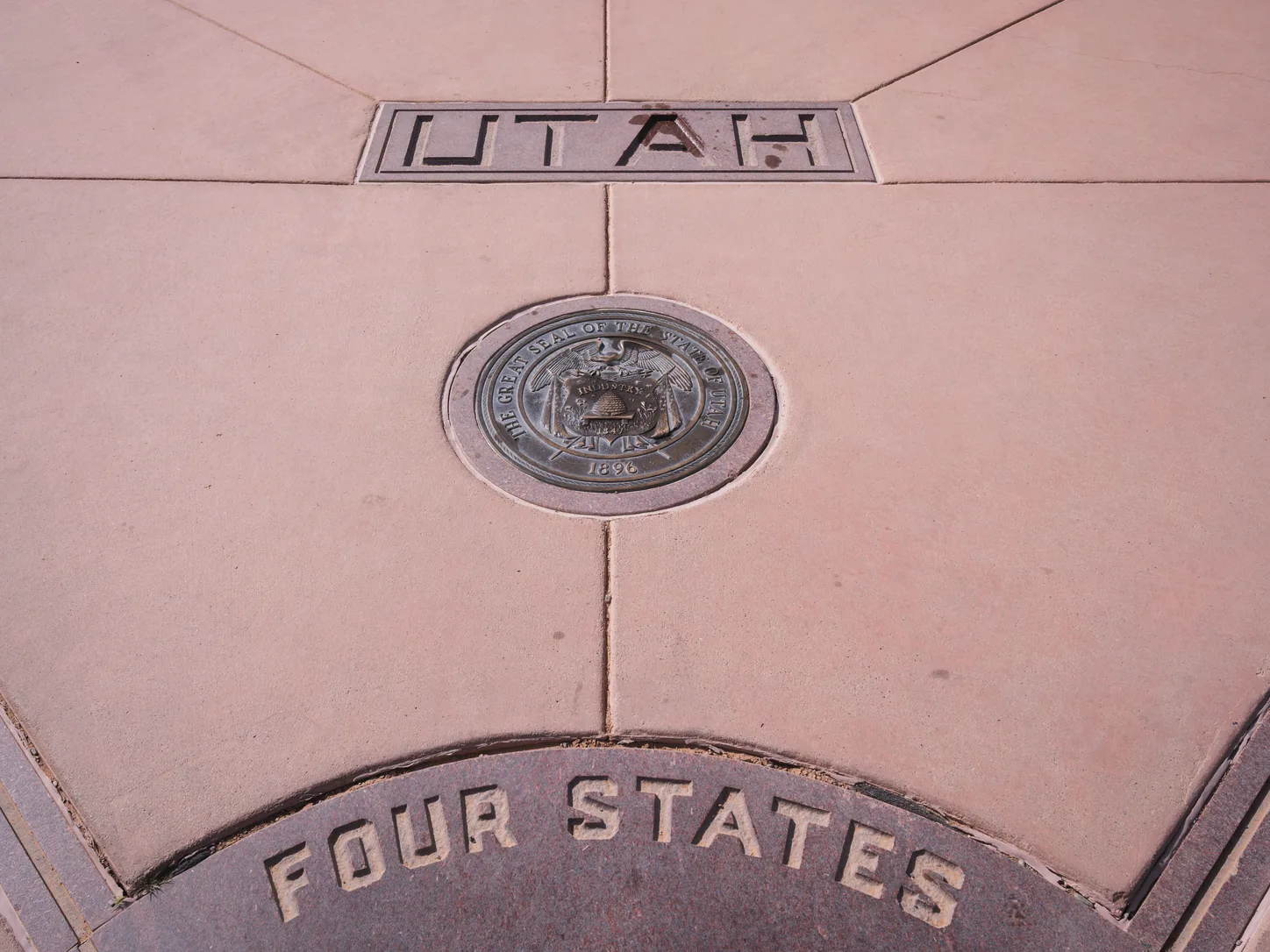
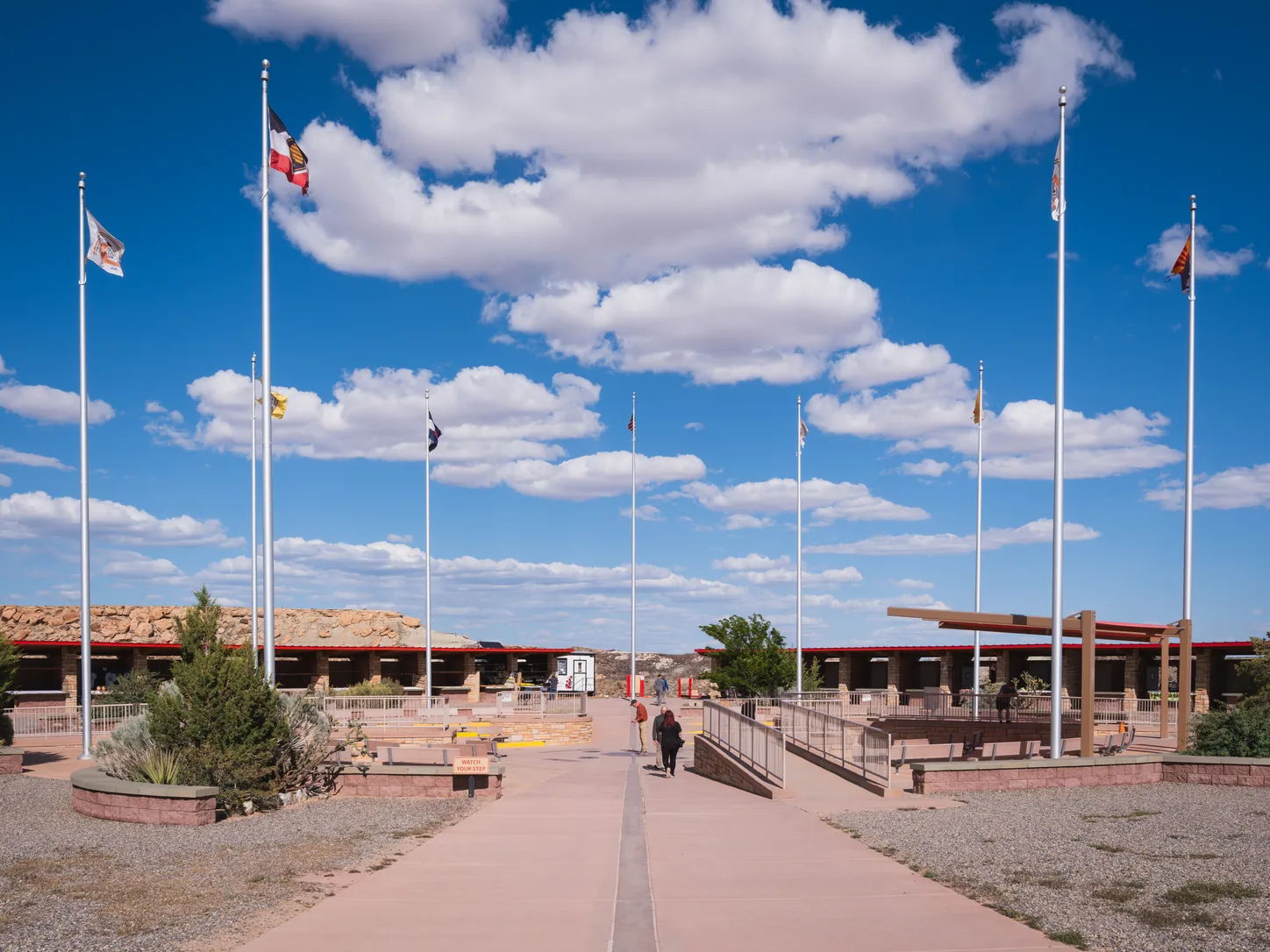
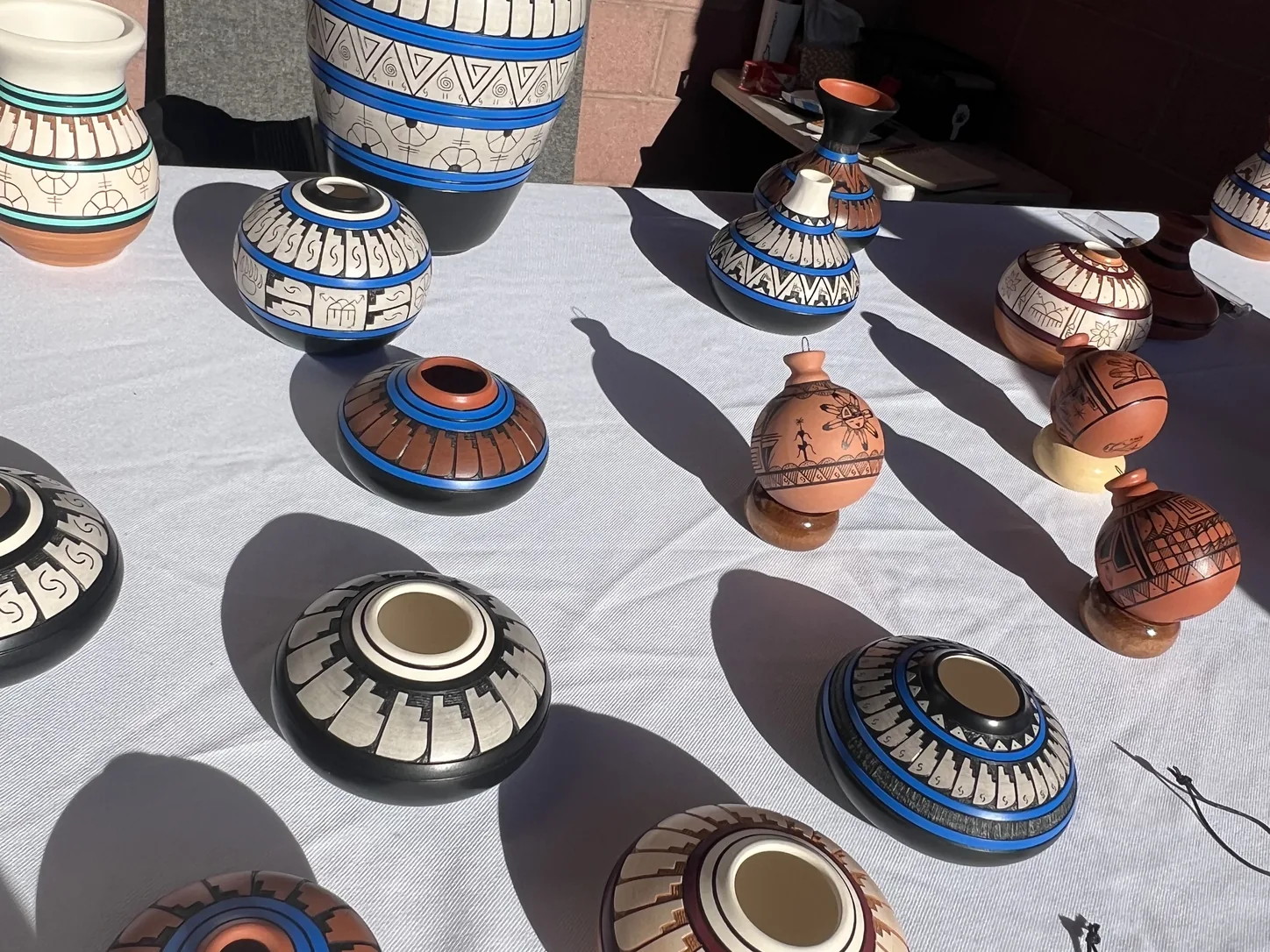
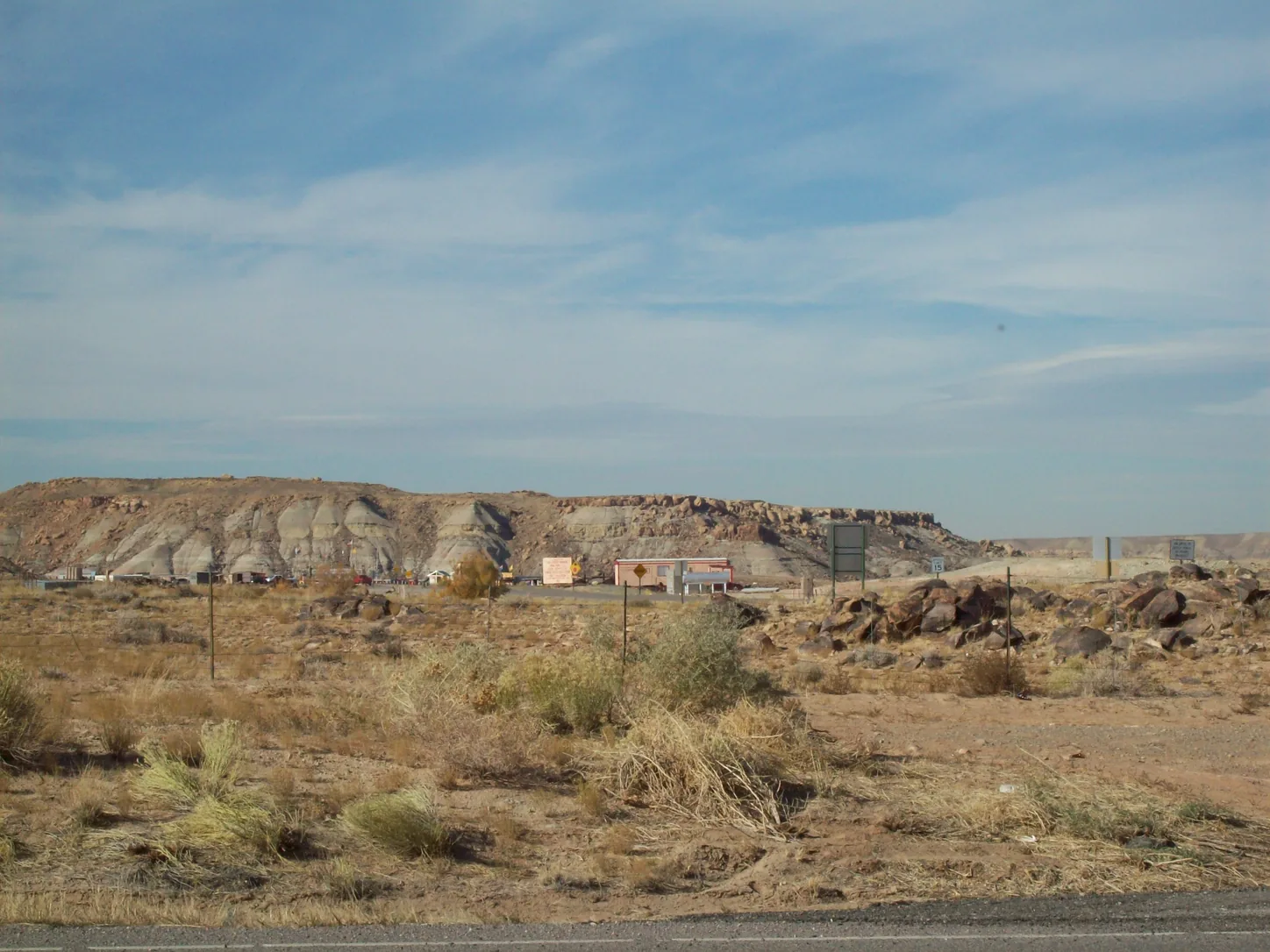
Photographs: Survey disc, plaza, Utah inscription and southern walkway — Christian David (CC BY-SA 4.0); Navajo and Hopi pottery — WendyAvilesR (CC BY-SA 4.0); The approach from US-160 — An Errant Knight (CC BY-SA 4.0). Reused from Wikimedia Commons under their Creative Commons licences; the full list, with a link to each file, is on about this site.
Six of the nearest tours, and what each one actually is
Ordered by distance from the marker rather than by price, because none of them goes to it and distance is the only honest way to rank them. Mesa Verde is about 49 miles away, Monument Valley 97, and the Las Vegas trips 448 — that last one is a different holiday, not a detour. Two more Las Vegas trips — the four-day Zion and Bryce run and the premium three-day — are the dearest here at US$866 and US$910 and sit on the full list of all eight. Neither of those goes to the monument either.
 Nearest & cheapest
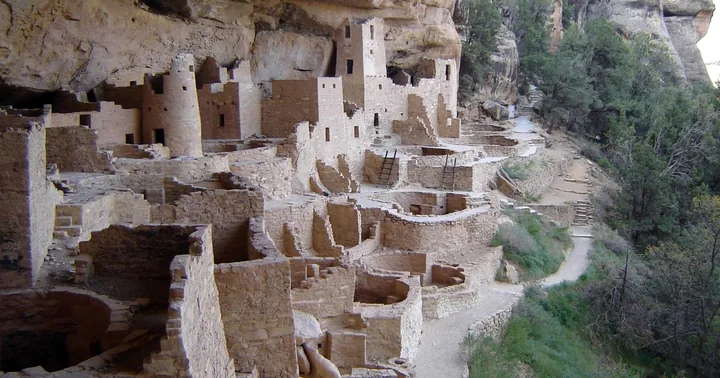
Mesa Verde: 700 Years Tour & Ranger-Guided Cliff Palace Visit
 Sees all four statesPark entry included
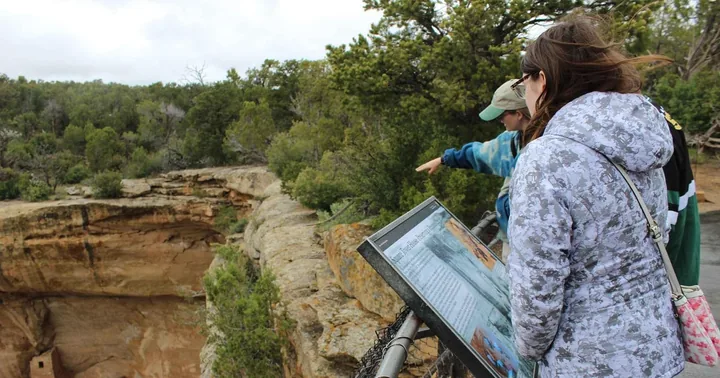
Mancos: Mesa Verde National Park Half-Day Tour
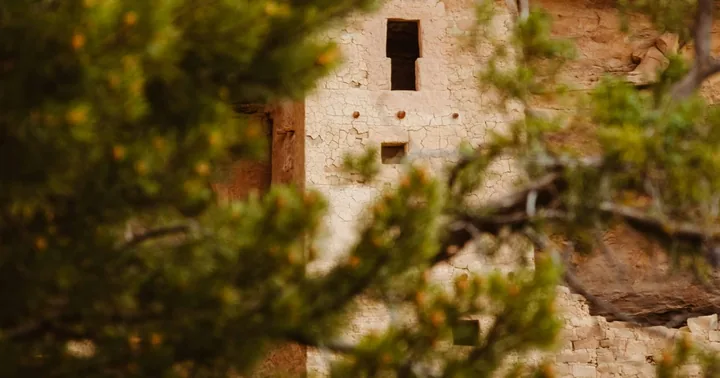 Best rated herePark entry + lunch included
Durango: Mesa Verde National Park, Cliff Palace Tour with Lunch
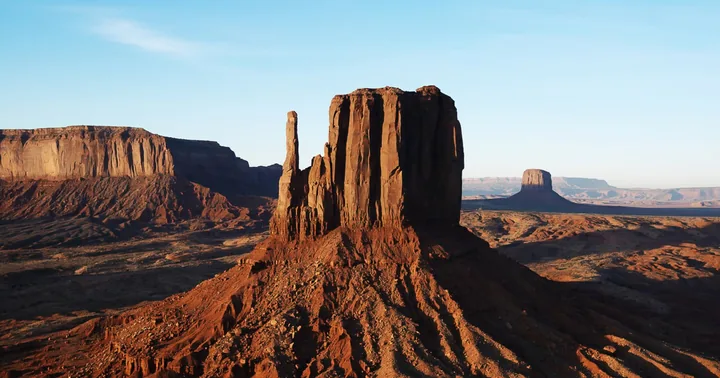 The other iconAll fees + lunch included
From Sedona or Flagstaff: Full-Day Monument Valley Tour
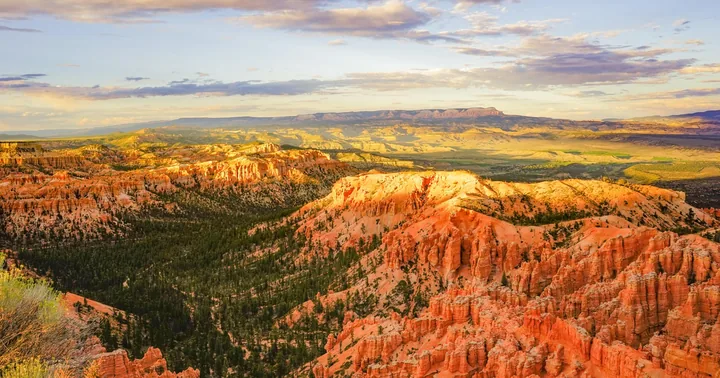 Cheapest multi-day
Vegas: 3-Day Ultimate Southwest Bucket List Small Group Tour
 Most reviewed
Las Vegas: Grand Canyon, Zion and Monument Valley 3-Day Tour
What travelers say about the tours near here
Verbatim reviews, first names and scores as published. Not one of them mentions Four Corners Monument, because not one of these tours goes there.
Very informative and knowledgeable guide extremely nice and helpful
Everything was very well organized, and our guide Cat was great. She explained everything well and showed us everything. It was a wonderful trip.
Our guide was very personable, knowledgeable, and had a great sense of humor. We have had several guided tours in the past but this one was by far the best. Jerry & Peggie
The Navajo guide who drove us around the valley was exceptional. He was both factually and culturally informative.
It was a great experience to be able to see all these canyons. It was an incredibly unique trip and experience. I can definitely recommend it.
Was a great experience. Competent, friendly guide. Maybe one participant too much for the van, too cramped for four people in the last row of seats.
Ratings and reviews are the operators’ live GetYourGuide figures. Read our full tour reviews ›
Quick answers before you drive
The five things people get wrong about this place, in the order they cost you the most.
Can I buy a ticket in advance?
No, and the evidence is stronger than a missing button: Navajo Nation Parks & Recreation runs a working online booking system covering Monument Valley and Antelope Canyon, and Four Corners is not in it. It is US$8 at the gate. The full working.
Does any tour on this page go to the monument?
No. Two Mesa Verde tours describe a viewpoint over the four-state region, which is a view from tens of miles away rather than the marker. Everything else is Monument Valley or Las Vegas. See what each one is.
How long do I need there?
Thirty to sixty minutes covers the line, the photograph and a walk past the stalls. It is a stop rather than a day out, and building a day around it is what leaves people flat. How much time you need.
Is it in the wrong place?
Not in law. The marker sits roughly 1,300 to 1,800 feet east of the meridian the statutes describe, because those statutes measured from Washington rather than Greenwich — and an accepted monument is the legal boundary regardless. The whole story.
What if the gate is shut?
It closes for New Year’s Day, Thanksgiving, Navajo Nation Family Day, Christmas and all other Navajo Nation holidays, and the tribal parks were closed for roughly sixteen months from March 2020. Nobody publishes live status: phone (928) 206-2540. Why it closes.
Can’t make these dates?
Browse more available Southwest tours near Four Corners and find one that fits your schedule — all with instant confirmation. Cancellation windows here run from 24 hours to 18 days before departure, and differ by tour — check the one you want.
The complete guide to visiting Four Corners Monument
This site is called four-corners-monument-tickets.com and the first thing it has to tell you is that the product in its own domain name does not exist. There is no Four Corners Monument ticket. Admission is US$8 per person, paid at the gate on arrival, charged per head rather than per vehicle, and nobody — not the Navajo Nation, not a reseller, not me — sells it in advance. I live in Cortez, 39 miles from the gate, and I drive out often enough to have learned the rest of this the slow way.
The fee, and why nobody sells a ticket for it
The absence of a ticket is easy to assert and hard to prove, so here is the proof I found most convincing. Navajo Nation Parks & Recreation already sells park entry online: there is a working booking widget on their entry-fee page, and it covers Monument Valley and Antelope Canyon. Four Corners is not in the bookable inventory. The operator has e-commerce, uses it for other parks, and has chosen not to put this one through it. The official Four Corners page carries no booking button, no ticket link, no price and no reservation language of any kind, and no official source — Navajo Parks, Discover Navajo, Visit Arizona, Visit Utah, New Mexico Tourism, Durango, Farmington — mentions advance tickets anywhere.
Three consequences follow, and they are the useful part. You cannot sell out a place that does not sell tickets, so there is no need to plan around availability. You cannot reserve a time slot, so arriving early buys you nothing but a shorter line at the disc. And anyone charging you in advance for entry to Four Corners Monument is selling you something else. That last one is worth reading twice if you have a booking confirmation in your inbox that you think covers the gate. More on whether you need tickets.
US$8 or US$5 — why you will find two prices
The current fee is US$8 per person. You will also find US$5 published, in good faith, on the official tourism sites for Durango and Farmington. US$5 was the historic rate; the Navajo Nation president’s office referred to US$8 per visitor collected in a July 2023 release. Publish the two numbers together and the confusion resolves itself: US$8 is what you pay, US$5 is what somebody forgot to update. Children 6 and under are reported free, and that is the only exemption any source documents — I have found nothing supporting senior, veteran or tribal-member discounts, so I do not print any. The full arithmetic of a visit, fuel included, is on what it costs.
Cash only, card only: two official answers
This one I cannot resolve for you, and I would rather say so than guess. Discover Navajo, the Navajo Tourism Department, states “CREDIT CARD PAYMENTS ONLY” in capitals. The Durango and Farmington tourism sites state cash only. Those are opposites, both are official, and Navajo Nation Parks & Recreation does not settle it either way on its own page. The card-only claim comes from the more authoritative and more recent source and matches the direction of travel everywhere else, but I am not going to tell you to arrive at a gate 39 miles from the nearest town holding only the payment method I guessed at. Carry both. If it matters — a full car, a tight budget, a long drive — phone (928) 206-2540 the day before.
Your national park pass is worthless here
Four Corners Monument is a Navajo Nation tribal park, formally Four Corners Monument Navajo Tribal Park, operated by Navajo Nation Parks & Recreation. It has never been proclaimed under the Antiquities Act, it is not a unit of the National Park Service, and there is no NPS.gov page for it. Navajo Parks states the consequence in capitals across its whole system: “WE do NOT Accept the National Park Pass.” America the Beautiful, the old Golden Age passes, none of them work. Everybody pays the US$8.
The misnomer is everywhere, including in official sources, which is why so many people arrive holding the wrong pass. Visit Utah manages to write that “Four Corners National Monument is administered by the Navajo Nation Parks and Recreation Department” — contradicting itself inside a single sentence. Durango files it under national parks and monuments. There is exactly one genuine federal thread, and it is narrower than it sounds: per NOAA’s National Geodetic Survey, the Bureau of Land Management administers the boundary survey monument as a legal survey mark, a duty inherited from the General Land Office. That is cadastral housekeeping. It does not make the visitor attraction a federal park, and it will not get you through the gate for free. Whose land this is, quadrant by quadrant, is on who owns it.
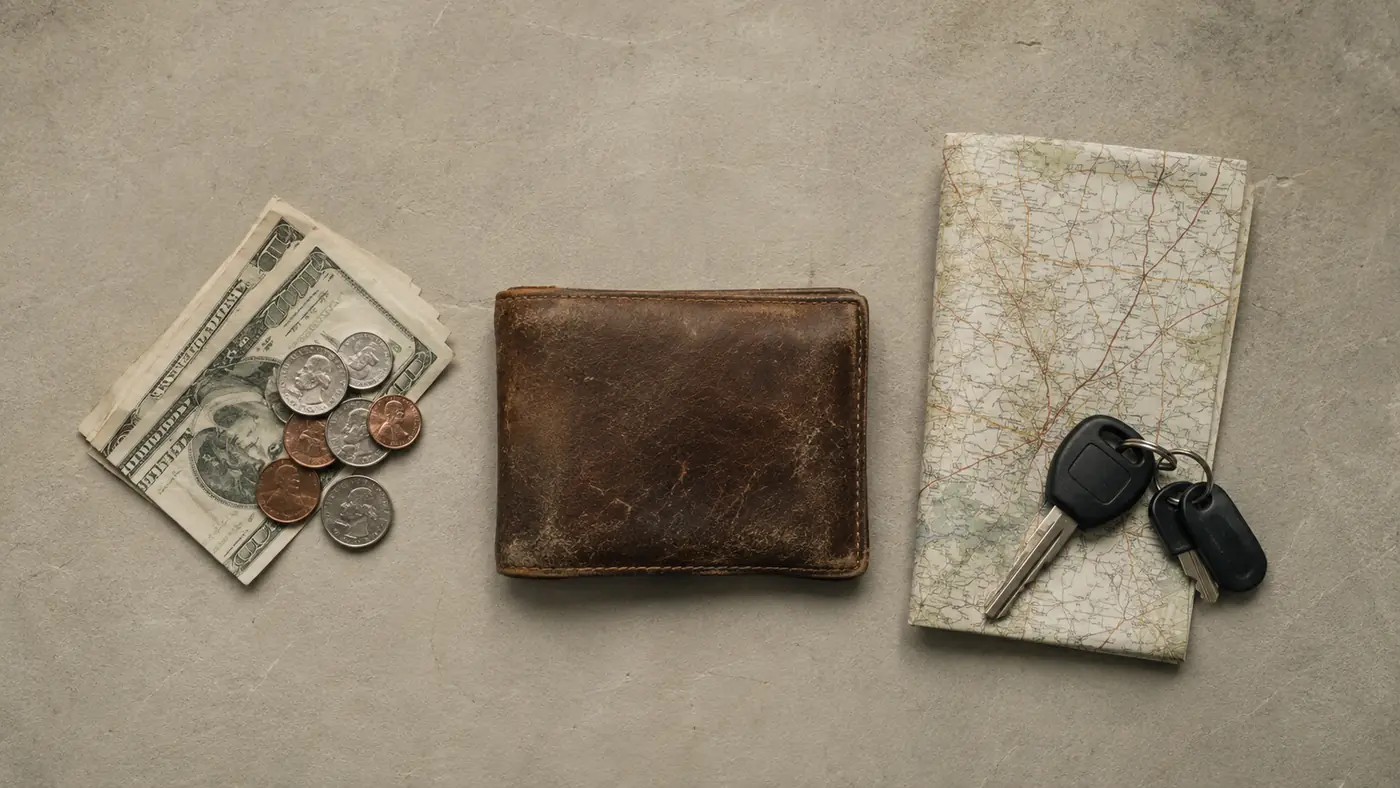
The time-zone trap, which is how people miss the gate
This is the one that costs people their whole afternoon, and it is not intuitive. The monument sits at Teec Nos Pos, Arizona — physically in Arizona, on the Navajo Nation. The Navajo Nation observes Daylight Saving Time. The rest of Arizona does not. The Navajo Nation Office of the President put the reason on the record in March 2026: the Nation keeps DST “in order to remain on the same time as many of our Diné relatives, communities, and services in Utah and New Mexico.”
So in summer the monument runs on MDT. Colorado, New Mexico and Utah are on MDT too, which means nothing changes as you step between three of the four states. The rest of Arizona — Phoenix, Flagstaff, Sedona, the Grand Canyon South Rim — is an hour behind. You are standing in Arizona, on Arizona soil, and the Arizona corner of that disc is an hour ahead of Phoenix.
Here is the hazard. Posted hours are Navajo Nation local time. A phone driving up from Phoenix or Flagstaff may be showing Arizona time and be an hour slow, and the cell towers out here straddle the zone boundary, so automatic time is not something I would stake a 200-mile round trip on. Trust it, arrive at what your screen calls 4:30pm for a 5:00pm winter close, and you have arrived at 5:30 with the gate shut. Set a watch to Colorado, New Mexico or Utah time in summer and stop thinking about it. In winter, DST ends, everything harmonizes on MST and there is no discrepancy at all. One extra wrinkle if you approach from the west: the Hopi Reservation, an enclave inside the Navajo Nation, is reported not to observe DST, though I have no primary Hopi source for that. All of it, in detail, on opening hours.
Hours: three official sources, three different tables
I lead with the operator’s own table, because it is the operator’s gate. Navajo Nation Parks & Recreation publishes 8:00am–8:00pm from 23 May to 14 August; 8:00am–7:00pm from 15 August to 30 September; 8:00am–5:00pm from 1 October to 27 March; 8:00am–6:00pm from 28 March to 30 April; and 8:00am–7:00pm from 1 May to 22 May. Every table anybody publishes opens at 8:00am. It is the closing time that moves.
Two other official sources disagree, and both are lower confidence than the operator, so treat them as a warning rather than a schedule. Discover Navajo lists 8am–5pm MDT, Monday to Saturday — much shorter, with a Sunday closure no other source mentions, on a page that also carries an internally inconsistent holiday date. Farmington and Utah’s Canyon Country list 8:00am–4:45pm in winter and 8:00am–5:45pm in summer, with season boundaries that do not match the operator’s. Sunday opening is genuinely unresolved: the operator implies seven days, Discover Navajo says six.
The planning fact worth more than any of that: the vendors and the office keep 8:00am–5:00pm daily, whatever the gate does. Turn up at seven on a July evening and you get the marker, the light and an empty plaza, and no craft market and no frybread. That is a fine trade if you know you are making it. As for a last-entry time, nobody publishes one. The recurring 4:45 and 5:45 closes in the secondary sources hint at a cut-off shortly before closing, but that is my inference and I am not going to dress it up as a rule.
When the gate is shut
The fixed closures are published and worth copying down: closed on New Year’s Day, Thanksgiving Day, Navajo Nation Family Day (the day after Thanksgiving), Christmas Day “and all other Navajo Nation Holidays.” That catch-all is the part that catches people. Navajo Nation holidays are not federal holidays, so an ordinary Tuesday everywhere else in the United States can find this gate closed.
If you are reading about a longer closure, it is almost certainly the pandemic one. The Navajo Nation closed its tribal parks in March 2020 and they are reported to have reopened on 6 July 2021 at 50% capacity, under Resolution CJN-36-21, with Four Corners among the six parks named — roughly sixteen months, one of the longest closures of any major attraction in the country. The reason it blindsided so many people is the reason it deserves writing down: that was a sovereign Navajo Nation public-health closure, not a federal or state one. Visitors holding federal passes went to NPS.gov to check and found nothing, because there is nothing there to find.
Two things I will not tell you. I will not tell you it closes for snow, because no source says it does; reduced winter hours are documented, weather closures are not. What is on record, from the president’s office in 2023, is that the parking areas turn to mud and flood after rain. And I will not give you live status, because nobody publishes it. As of August 2026 the evidence points firmly to open: the Navajo Nation Office of the President announced new restrooms at the monument on 4 August 2026, and an agency does not open a facility at a shuttered park. Navajo Parks’ homepage does carry an excessive-heat closure of park trails running to 1 September 2026 and Stage 2 fire restrictions; neither names Four Corners, which has no trails, but I cannot confirm the scope. Phone (928) 206-2540. On a site with this closure history that is substance, not boilerplate. More on why it closes.
What a visit actually consists of
You pay at the booth. You walk out onto a low, open plaza at about 4,861 feet — a USGS elevation query returns 4,860.92 ft at the point, and a National Geodetic Survey mark 170 meters east reads 4,852 ft. You wait your turn. You straddle the disc, or lie across it, so that an arm and a leg are in four states at once, and somebody takes the photograph. Then you walk the ring of vendor stalls on the way back to the car. A typical visit runs 30 to 60 minutes, and every honest answer to “how long do I need” starts by admitting that this is a stop rather than a day out.
The center marker is a disc set in granite, installed in 1992 by the Bureau of Land Management; the on-site plaque is where that date and attribution come from. The original 1912 marker was a plain cement pad. The plaque also names the four surveyors whose work put the corner where it is, and records restorations in 1899, 1931, 1962 and 1992. Around the plaza, Navajo vendors sell handmade silver and turquoise jewelry, hand-woven rugs, ceremonial baskets and traditional food including frybread and Navajo tacos, and a demonstration center hosts artisans. The stalls are independently operated, and how many are trading varies with the season, the weather and the day — in winter and on summer evenings, expect few or none. I am not going to promise you can buy lunch there. The site takes around 250,000 visitors a year, per a 2025 figure from the president’s office, and in July you will feel every one of them in the line for the disc.
Four things are prohibited and people get caught out by two of them. Drones are banned at all Navajo Tribal Parks and Navajo Parks says they “will be confiscated”. Dogs are prohibited, with fines under Navajo Nation law. Littering, rock climbing and camping are out as well. More on what there is to do and how much time you need.
The restrooms are new, and dated 4 August 2026
Nearly every guide on the internet will tell you that Four Corners has portable toilets. Those guides are now out of date. On 4 August 2026 the Navajo Nation Office of the President announced that new restroom facilities have opened at the monument: eight women’s restrooms including one ADA-accessible unit, four urinals, three men’s stalls and one ADA-accessible men’s restroom. The project cost US$3.58 million in total — US$673,675 of water infrastructure, US$1,000,957.79 of power, US$345,653.28 of demolition, US$1,212,500 of design and build and US$343,500 of geotechnical work. The previous building was described as structurally unsound and was demolished. A master plan for visitor amenities, signage and infrastructure is planned.
Water service reached the site in 2016 and the 2026 project preserved the existing water and septic infrastructure, so there is plumbing out there. Whether there is drinking water for visitors is not stated anywhere I could reach, so bring your own regardless — at these temperatures on an unshaded slab, that is not a nicety. For fuel and supplies the nearest option is a trading post 6.5 miles away with groceries and gas; there is nothing at the monument itself, and services within a 30-mile radius amount to small cafes, grocery stores and self-service gas pumps. Details on food and facilities.
Is it in the wrong place? Not in law, and the popular version is wrong twice
The marker sits roughly 1,300 to 1,800 feet east of the meridian the organic acts describe. Dave Doyle, then Chief Geodetic Surveyor at NOAA’s National Geodetic Survey, put the offset at 1,807.14 feet. NGS’s own page hedges that the offset “is in fact only about 1800 feet, or less,” and a NOAA podcast with Doyle gives a range of about 1,350 to 1,800 feet. Three NOAA numbers, three answers, because the result depends on which historical value of the Washington meridian you adopt, and NGS has never published which constant Doyle used. So the range is the fact and the precise figure belongs to Doyle rather than to me.
The reason for the offset is arithmetic, not incompetence. The statutes never said 109 degrees west of Greenwich. They said the 32nd meridian of longitude west from Washington — the Old Naval Observatory, adopted as the American prime meridian by an Act of 28 September 1850 and not repealed until 1912. Convert that described line with a modern value and it lands about 1,800 feet west of the marker. The “2.5 miles off” claim you will find on a hundred travel sites comes from assuming Greenwich; under that wrong assumption the marker is 2.498 miles west of 109 degrees west, and the number is a myth built on the wrong prime meridian. The direction is the second thing everyone reverses: the marker is east of the statutory meridian, and west of 109 degrees west measured from Greenwich.
The statutes themselves are still live law, which is the detail I like most. The Colorado Organic Act of 28 February 1861 bounded the territory by the 25th and 32nd meridians west from Washington, and that wording is still quoted verbatim in Article I of the Colorado Constitution today. New Mexico’s Constitution, Article I, still defines its western boundary as “the thirty-second meridian of longitude west from Washington.” Arizona’s Organic Act of 24 February 1863, signed by Lincoln, defines the line as running due south “from the point where the southwest corner of the Territory of Colorado joins the northern boundary of the Territory of New Mexico” — which is to say Arizona’s eastern boundary is legally defined as starting from wherever the surveyor put Colorado’s corner. There is no 1868 Act of Congress setting any of this, whatever you read elsewhere; 1868 is the year of Ehud N. Darling’s survey, and NGS’s own page cites 1863.
Darling surveyed the 37th parallel as the Colorado–New Mexico line in 1868 and set a monument where he took the meridian to be. Chandler Robbins, contracted by the General Land Office, set the corner on 10 July 1875 with, in the contemporary description, “a shaft of hard sandstone, 7 feet long, 12 inches wide and 6 inches thick; set 3 feet in the ground.” Robbins landed 1 mile 45 chains east of Darling’s monument, and later work showed the error was Darling’s rather than Robbins’s. Rollin J. Reeves ran the Colorado–Utah line in 1878 and Howard B. Carpenter the Arizona–Utah line in 1901.
And then the part that settles it. NGS’s page on the subject is titled “Why the Four Corners Monument is in Exactly the Right Place,” and it states that once a monument has been established and accepted by the parties involved, “the location of the physical monument is the ultimate authority in delineating a boundary.” Doyle put it more bluntly: “Even if it’s 10 miles off, once it’s adopted by the states … the numerical errors are irrelevant. It becomes the legal definition.” The US Supreme Court decided the principle in New Mexico v. Colorado, 267 U.S. 30, on 26 January 1925: New Mexico sued to replace Darling’s line with a more accurate 1903 resurvey and lost, the Court holding that governments are bound by the practical line established as their boundary “although not precisely a true one.” That is the very line that runs east and west through this marker. Colorado’s own statute books carry an editor’s note to Article I saying the actual boundaries differ from the legal description, and citing the case. Federal law says the same in general terms at 43 U.S.C. § 752: the boundary lines actually run and marked in the surveys returned are the proper boundary lines.
One honest caveat, because the internet gets this wrong in the other direction too: the quadripoint itself has never been litigated. The 1925 case is about the line running through it. The right phrasing is that the corner has never been challenged, not that it has been upheld. The long version, with the myth taken apart properly, is on is it in the wrong place.
Whose land you are standing on
Three of the four quadrants are Navajo Nation: Utah’s San Juan County to the northwest, Arizona’s Apache County to the southwest, and New Mexico’s San Juan County to the southeast, in the Teec Nos Pos Chapter. The fourth, northeast into Montezuma County, Colorado, is the Ute Mountain Reservation. So the boundary between the Navajo Nation and the Ute Mountain Ute Tribe here is the 37th parallel, which is also the Colorado state line, running due east and west straight through the marker. Stand with your feet either side of the horizontal line and you are straddling two sovereign nations as well as two states. The on-site plaque says the same thing, and the quadrant geography checks out against the federal reservations layer in the Census Bureau geocoder.
I am a non-Native photographer from Cortez and this site is not the Navajo Nation, Navajo Nation Parks & Recreation, the Ute Mountain Ute Tribe or the National Park Service. Where the answer belongs to the Nation — the fee, the hours, the rules, what is permitted, when the gate opens — the right source is Navajo Nation Parks & Recreation, not me repeating them in my own words. The four states, for the record, are Arizona, Colorado, New Mexico and Utah, and this is the only point in the United States where four of them meet: see which four states and whose land it is.
Getting there, and how far it really is
No state DOT and no federal agency publishes a distance table from Four Corners, so I routed one with OSRM on OpenStreetMap data and I am telling you that up front. These are free-flow numbers: no stops, no construction, no weather, and none of the reduced speeds that are normal on US-160, US-163 and US-491. Real-world driving runs 15 to 30 percent longer, so take the ranges rather than the point estimates.
Cortez, Colorado is 39 road miles, about 45 minutes to an hour. The Mesa Verde National Park entrance is 49 miles, an hour to an hour and twenty. Durango is 85 miles, an hour and a half to two hours. Monument Valley is 97 miles, two to two and a half hours. Moab is 145 miles, three to three and three quarters. Flagstaff is 227 miles and the Grand Canyon South Rim 230, both four and a half to five and a half hours. Albuquerque is 244 miles. The Grand Canyon North Rim is 302 miles, six to seven hours, and it is closed from mid-October to mid-May. Phoenix is 370 miles, seven to eight hours. Denver is 418 miles, eight and a half to ten. Las Vegas is 448 miles, the same again.
Two traps worth passing on. When people search “Grand Canyon” without qualifying it, they almost always mean the South Rim; the North Rim looks closer on a map and is a longer, seasonal drive. And the National Park Service describes Mesa Verde as a one-hour drive from Cortez, which confuses people because the park entrance is only about 10 miles out of town. NPS means reaching the mesa-top cliff dwellings: add roughly 45 minutes beyond the entrance station. The whole table, with the method spelled out, is on getting there, and beds are on where to stay.
When to go
There is no weather station at Four Corners, so the numbers below are NOAA NCEI 1991–2020 monthly normals for Farmington Regional Airport, New Mexico, 55 miles east-southeast at 5,495 feet. The monument sits about 635 feet lower, so expect it a few degrees warmer than these. January averages a high of 43.0°F and a low of 19.2°F. April: 67.4 and 35.3. July: 93.3 and 60.9. October: 68.8 and 37.8. There is no shade on that plaza that any source describes, and I have never found any.
The monsoon matters more than the temperature. The National Weather Service season runs 15 June to 30 September, and the Farmington normals bear it out: June is the driest month of the year at 0.20 inches, then rainfall roughly triples from July through September and peaks in September at 1.06 inches. That means June is hot and bone dry, and July through September brings afternoon thunderstorms, flash flooding and brief road closures — plus the mud in the parking areas that the president’s office noted in 2023. As a photographer I would take late September or early October over July without hesitating: cooler, longer shadows, and storm light on the mesas that midday summer sun on a pale slab cannot come close to. More on the best time to visit.
The question I am not going to answer
Which is the best Four Corners Monument tour. I get why the question exists, and I am not going to rank an answer to it, because there is nothing to rank. No product on the booking platform visits the monument. The platform has no location page for it — only Four Corners, Florida, and Four Corners of Law in Charleston — and the single occurrence of the phrase “Four Corners Monument” in its listings that search engines index is a customer review complaining that a tour did not go there. The big Southwest multi-day operators route around it: it sits an hour and a half to two hours off the Las Vegas, Page and Flagstaff circuit and adds a paid tribal gate stop.
What I list instead is the eight nearest bookable things to the drive you are already making, ordered by distance from the marker rather than by price, and each one labeled with what it actually is. Two of the Mesa Verde tours mention Four Corners in their own copy, and both mean a viewpoint over the region: one describes “a stop at a spectacular lookout of the Four Corners Region,” the other “one of the most spectacular viewpoints in the Southwest, where you can see into the four states that make up the four corners region.” That is a view across four states from tens of miles away, with no gate fee attached — genuinely interesting, and genuinely not the marker. If somebody sells you one of those as a Four Corners Monument tour, they have misread their own itinerary. See the eight tours and the reviews.
When I would not make the drive
Denver is 418 miles away and Las Vegas 448. A 30-to-60-minute stop does not justify either of those on its own, and pretending otherwise would be the easiest lie on this site. If you are not already crossing the Colorado Plateau — Mesa Verde, Monument Valley, Moab, Durango, the San Juans — then Four Corners is a long way to go to stand on a disc. I would also skip it if you are arriving late on a summer evening and wanted the craft market, if you are traveling with a dog, or if the day you have free happens to be a Navajo Nation holiday and you have not phoned to check.
If you are already out here, it is 39 miles from Cortez and 49 from the Mesa Verde entrance, and it is the only place in the country where you can do this particular silly, satisfying thing. My own honest verdict, at more length, is on is it worth it.
The bottom line
For most people reading this, the right answer costs eight dollars and books nothing. Drive yourself, check the day, set your watch to Navajo Nation time, carry cash and a card, arrive with water, pay at the booth, wait your turn, take the photograph, buy something from the stalls if anyone is trading, and be back on US-160 within the hour. If you want more of a day out of it, add Mesa Verde 49 miles east, where guided tours genuinely run and where one of them will show you four states from a distance. But do not go looking for a Four Corners Monument ticket. There has never been one to buy.
Frequently asked questions
Do you need tickets for Four Corners Monument?
No, and you could not buy one if you wanted to. Admission is US$8 per person paid at the gate on arrival, with no timed entry and no reservation of any kind — so the monument cannot sell out, and anyone charging you in advance is selling you something else. How that was established.
How much does it cost to go to Four Corners Monument?
US$8 per person, charged per head rather than per vehicle, bus passengers included. Children 6 and under are reported free, the only exemption anyone documents. You will still find US$5 on the Durango and Farmington tourism sites; that is the old rate. Full breakdown on what it costs.
Is there a tour that goes to Four Corners Monument?
Not one that I can find, and I looked hard. The booking platform has no location page for the monument, and the only mention of it anywhere in its listings is a customer review complaining that a tour skipped it. Two Mesa Verde tours describe a viewpoint over the four-state region, which is a view from tens of miles away and not the marker. What the eight nearest tours actually are.
What time does Four Corners Monument open?
Navajo Nation Parks & Recreation publishes 8:00am–8:00pm from 23 May to 14 Aug, 8:00am–7:00pm from 15 Aug to 30 Sep, 8:00am–5:00pm from 1 Oct to 27 Mar, 8:00am–6:00pm from 28 Mar to 30 Apr and 8:00am–7:00pm from 1 May to 22 May. Two other official sources publish different tables, and the vendors keep 8:00am–5:00pm whatever the gate does. All three tables, side by side.
Do I need to change my watch at Four Corners?
Probably, in summer. The Navajo Nation observes Daylight Saving Time and the rest of Arizona does not, so from spring to fall the monument runs on MDT with Colorado, New Mexico and Utah, and an hour ahead of Phoenix, Flagstaff, Sedona and the Grand Canyon South Rim. A phone driving up from Phoenix may show Arizona time and be an hour slow. The time-zone trap.
Why is Four Corners Monument closed?
If you are reading about a long closure, that is the Navajo Nation’s own public-health closure of its tribal parks from March 2020, reported as reopening on 6 July 2021 — a sovereign closure, which is why federal passholders checking NPS.gov found nothing. It also closes for Navajo Nation holidays that are not federal holidays. The closure history.
Is Four Corners Monument in the wrong place?
No, not in law. It sits roughly 1,300 to 1,800 feet east of the meridian the statutes describe — Dave Doyle, then Chief Geodetic Surveyor at NOAA’s National Geodetic Survey, put it at 1,807.14 feet — because the statutes measured from Washington, not Greenwich. An accepted boundary monument is the boundary. The full story, including the myth.
Are there restrooms and food at Four Corners Monument?
There are new restrooms, opened on 4 August 2026 in a US$3.58 million project announced by the Navajo Nation Office of the President. Navajo vendors sell frybread and Navajo tacos alongside jewelry and rugs from 8:00am to 5:00pm, but the stalls are independently run and no one guarantees any will be trading. Bring water. Food and facilities.
Still have questions? Email us [email protected]